Lump Sum Mortgage Payoff Calculator: What One Big Payment Does
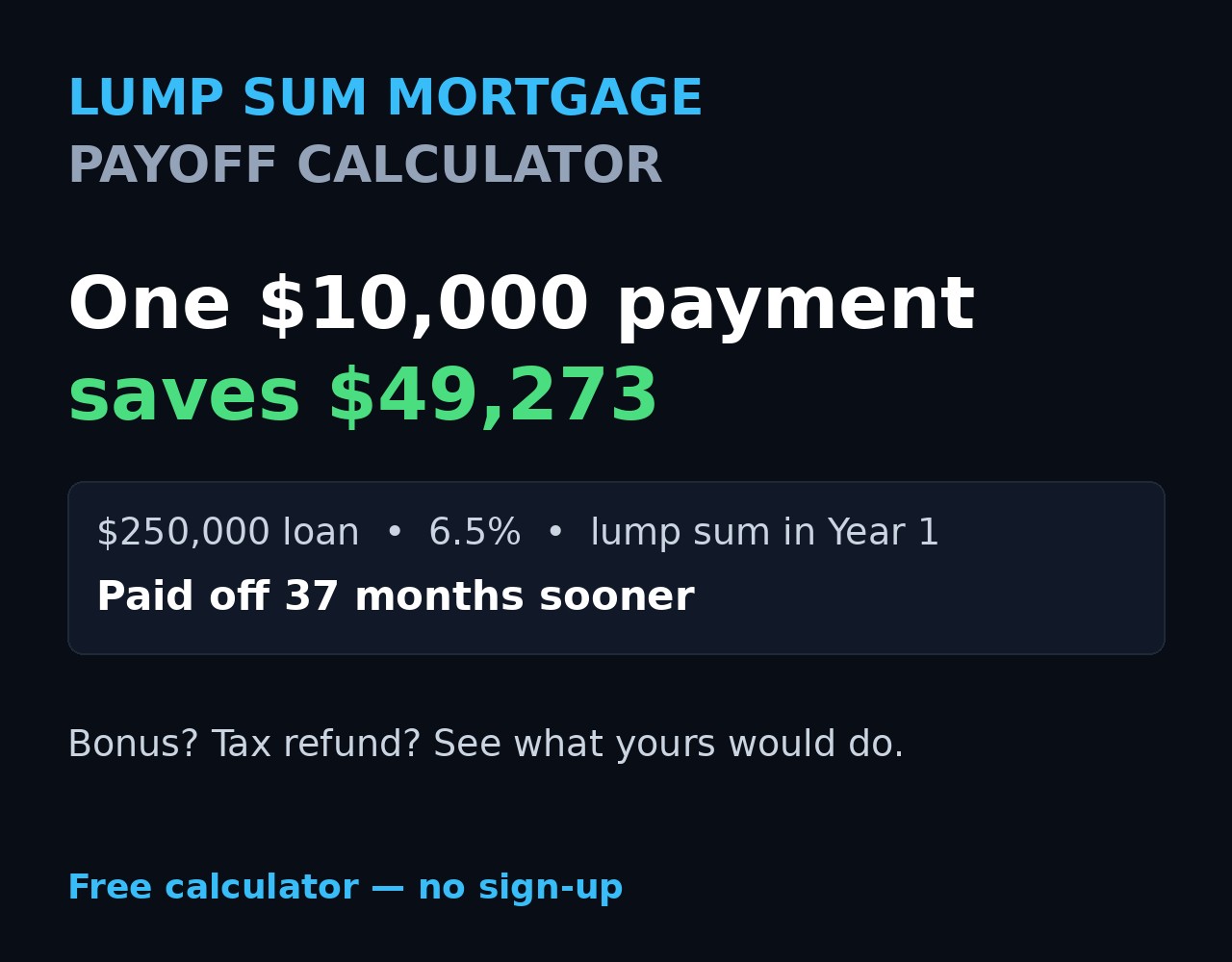
A bonus, a tax refund, an inheritance — when a lump sum lands in your lap, putting it on the mortgage can be worth several times its face value. On a $250,000 loan at 6.5%, a single $10,000 lump sum in the first year saves $49,273 in interest and cuts 37 months off the loan. This calculator shows exactly what your lump sum would do.
Calculate Your Lump Sum's Effect
The calculator below is pre-set with a $10,000 one-time payment in month 12. Change the amount and the month to match your plans — the payoff time, interest saved, chart and schedule update instantly. You can combine a lump sum with monthly extras too:
Loan Parameters
Extra Payments
| Period | Payment | Principal | Extra | Interest | Balance |
|---|
Timing Is Everything: The Same $10,000 at Three Different Moments
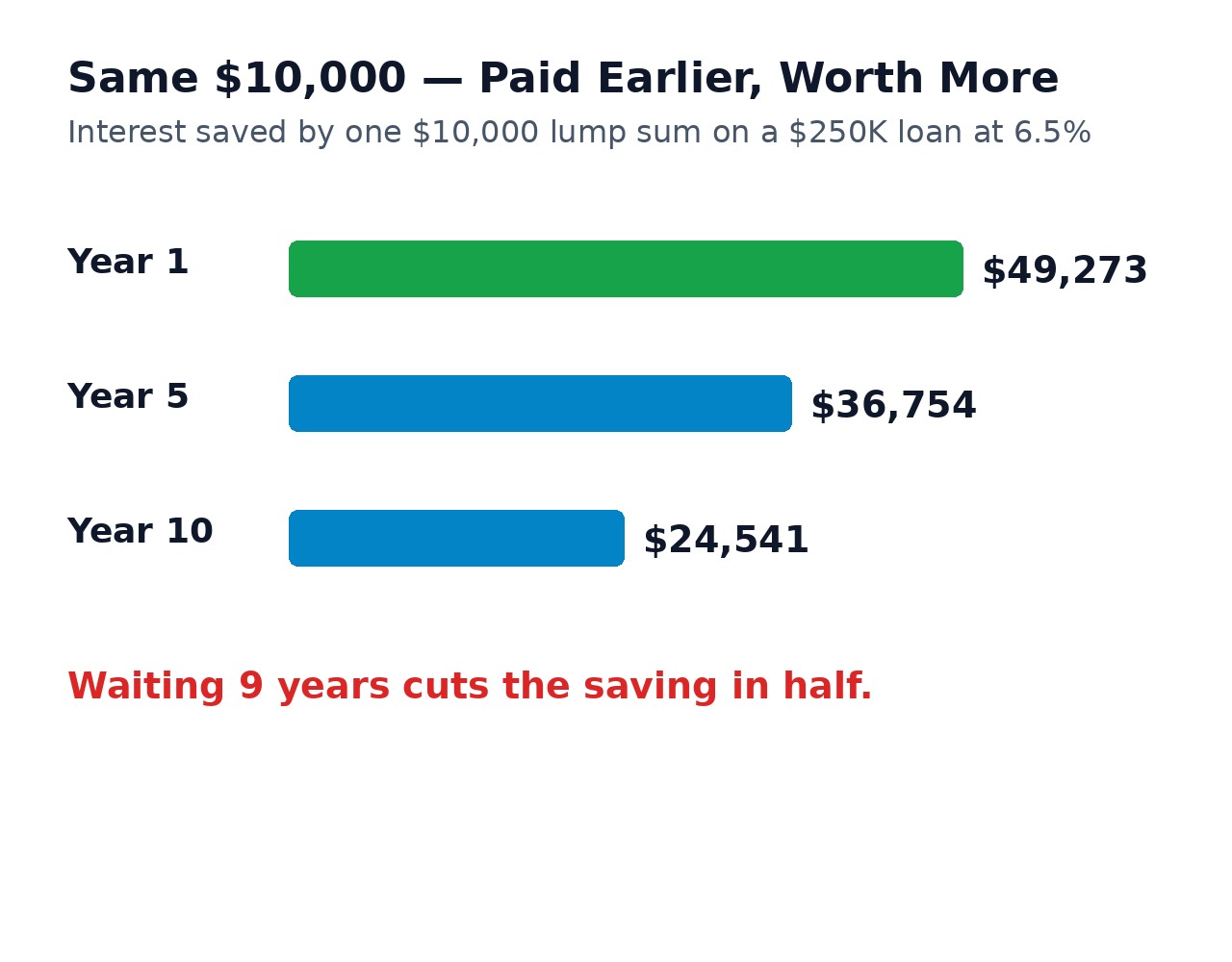
A lump sum deletes every future month of interest on the money you remove — so when you pay matters almost as much as how much:
| $10,000 Paid In | Paid Off In | Total Interest | Interest Saved | Time Saved |
|---|---|---|---|---|
| Month 12 (Year 1) | 26 yrs 11 mos | $269,588 | $49,273 | 3 yrs 1 mo |
| Month 60 (Year 5) | 27 yrs 7 mos | $282,107 | $36,754 | 2 yrs 5 mos |
| Month 120 (Year 10) | 28 yrs 3 mos | $294,320 | $24,541 | 1 yr 9 mos |
Waiting 9 years costs that $10,000 half its power — $49,273 of savings shrinks to $24,541. If the money is truly spare, earlier is mathematically better.
Bigger Lump Sums on the Same Loan
| Lump Sum (Month 12) | Paid Off In | Interest Saved | Time Saved |
|---|---|---|---|
| $10,000 | 26 yrs 11 mos | $49,273 | 3 yrs 1 mo |
| $25,000 | 23 yrs 2 mos | $105,370 | 6 yrs 10 mos |
| $50,000 | 18 yrs 5 mos | $170,231 | 11 yrs 7 mos |
Lump Sum vs Monthly Extra: Which Is More Efficient?
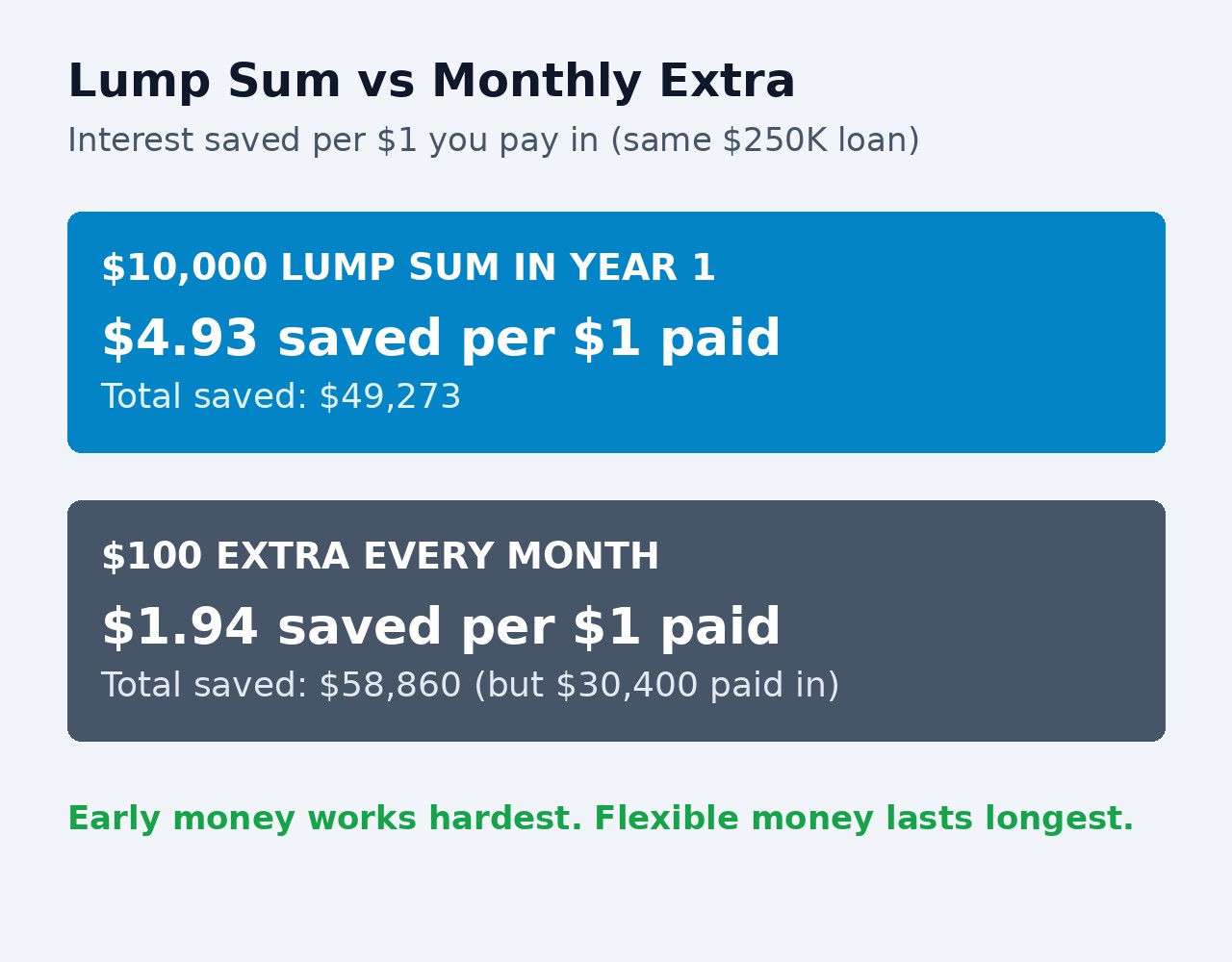
They are different tools, so compare them per dollar you actually hand over:
- $10,000 lump sum in Year 1: you pay in $10,000 once and save $49,273 — about $4.93 saved per $1 paid.
- $100 extra every month: you pay in $30,400 over the loan's life and save $58,860 — about $1.94 saved per $1 paid (see the full breakdown in our extra $200 a month guide).
Per dollar, an early lump sum is the most efficient move in mortgage payoff — because the whole amount starts deleting interest from day one. Monthly extras win on flexibility: you can pause them. Many people do both: lump sums when windfalls arrive, plus a modest monthly extra. Model any mix in the main mortgage payoff calculator with extra payments and see the year-by-year result in the amortization schedule calculator.
Before You Send a Lump Sum (3 Checks)
- Keep your safety net: money sent to principal cannot be pulled back out. Keep an emergency fund outside the mortgage first.
- Mark it "principal only": tell your servicer in writing (or in the portal) that the payment is a principal curtailment, not an early monthly payment.
- Check for a prepayment penalty and confirm there is no per-year curtailment cap on your loan. Most modern loans have neither — one call confirms it.
Frequently Asked Questions
1. Is it better to pay a lump sum or spread it out monthly?
Per dollar, paying early wins: interest is charged on the balance every month, so money applied sooner deletes more future interest. A $10,000 lump in Year 1 saves $49,273; the same $10,000 spread thinly over many years saves noticeably less.
2. What is a principal curtailment?
It is the lender's term for an extra payment applied directly to your loan balance. It does not change your required monthly payment — it shortens the loan and cuts total interest instead.
3. Will a lump sum lower my monthly payment?
Not by itself. Your scheduled payment stays the same; you simply finish years earlier. To lower the payment itself you would need a recast — some servicers offer one for a fee after a large lump sum. Ask yours.
4. How big does a lump sum need to be to matter?
Smaller than most people think. Because early money deletes decades of interest, even $5,000 in the first years of a typical loan saves well over $20,000. Enter your amount above and see your exact figure.