Amortization Schedule With Extra Payments Calculator (Free, Printable)
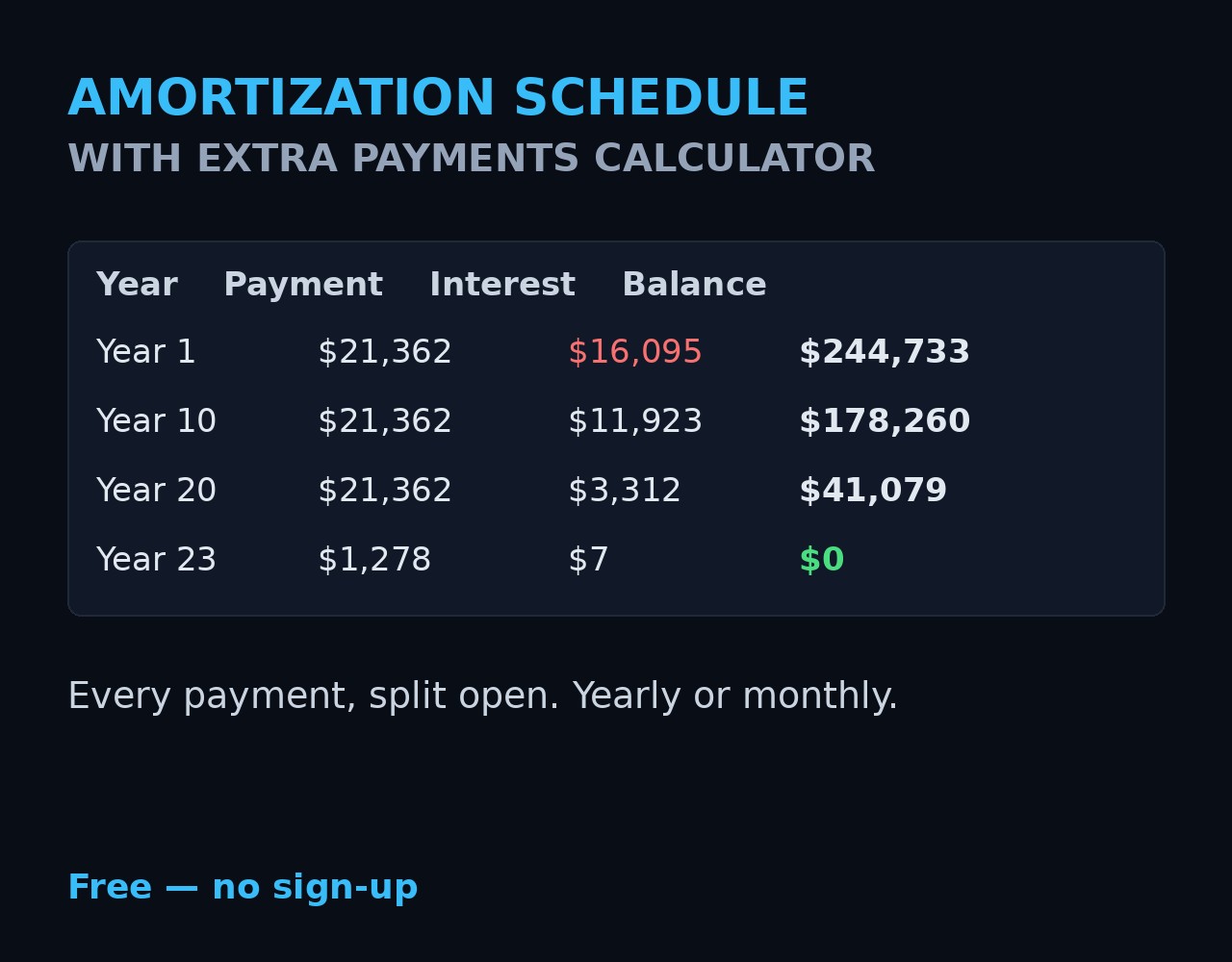
An amortization schedule is the full map of your mortgage: every payment, split into principal, extra principal and interest, with your balance after each one. This free calculator builds yours instantly — with your extra payments included — in a yearly or monthly view you can read, print and keep.
Build Your Amortization Schedule (With Extra Payments)
Enter your loan and any extra payments below. The schedule under the chart updates instantly — switch between Yearly and Monthly views, and watch the Interest column shrink as extra payments bite:
Loan Parameters
Extra Payments
| Period | Payment | Principal | Extra | Interest | Balance |
|---|
How to Read Your Schedule (5 Columns)
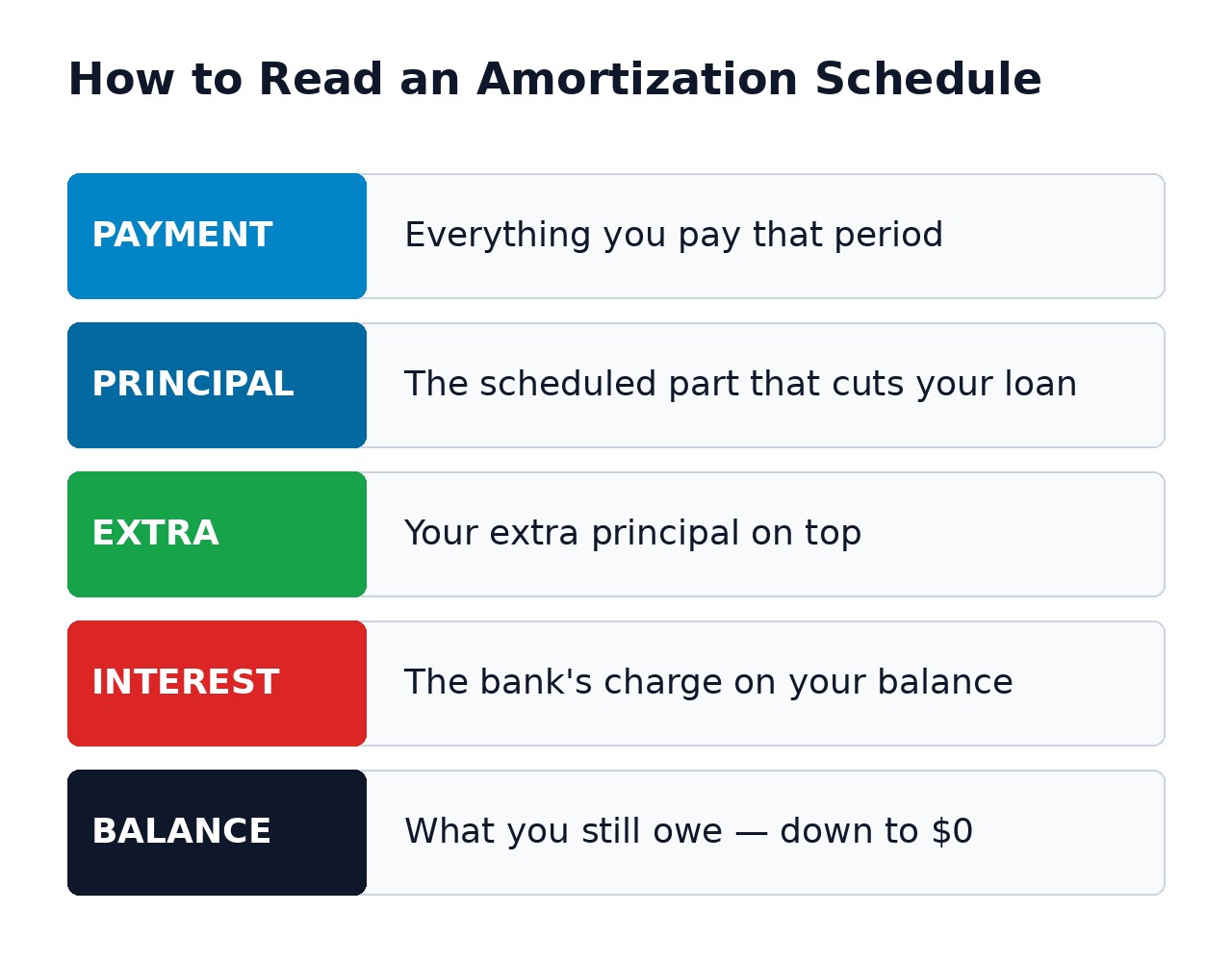
- Payment — everything you pay in that period (principal + extra + interest).
- Principal — the scheduled part of your payment that reduces the loan, before extras.
- Extra — your extra principal for that period (monthly extra, plus any annual or one-time lump sums).
- Interest — what the bank charges that period: your previous balance × the monthly rate. This is the column extra payments attack.
- Balance — what you still owe at the end of the period. When it reaches $0, you are done — months or years early.
Example Schedule: $250,000 at 6.5% With an Extra $200/Month
This is the exact yearly schedule the calculator produces for the example loan. Notice two things: you pay the same $21,362 every year, but the interest column falls every single year while the principal column grows — and the loan ends in Year 23 instead of Year 30:
| Year | Payment | Principal | Extra | Interest | Balance |
|---|---|---|---|---|---|
| Year 1 | $21,362 | $2,867 | $2,400 | $16,095 | $244,733 |
| Year 2 | $21,362 | $3,220 | $2,400 | $15,742 | $239,113 |
| Year 3 | $21,362 | $3,596 | $2,400 | $15,366 | $233,117 |
| Year 4 | $21,362 | $3,998 | $2,400 | $14,964 | $226,719 |
| Year 5 | $21,362 | $4,426 | $2,400 | $14,536 | $219,893 |
| Year 6 | $21,362 | $4,883 | $2,400 | $14,079 | $212,609 |
| Year 7 | $21,362 | $5,371 | $2,400 | $13,591 | $204,838 |
| Year 8 | $21,362 | $5,892 | $2,400 | $13,070 | $196,546 |
| Year 9 | $21,362 | $6,447 | $2,400 | $12,515 | $187,699 |
| Year 10 | $21,362 | $7,040 | $2,400 | $11,923 | $178,260 |
| Year 11 | $21,362 | $7,672 | $2,400 | $11,290 | $168,188 |
| Year 12 | $21,362 | $8,346 | $2,400 | $10,616 | $157,442 |
| Year 13 | $21,362 | $9,066 | $2,400 | $9,896 | $145,976 |
| Year 14 | $21,362 | $9,834 | $2,400 | $9,128 | $133,742 |
| Year 15 | $21,362 | $10,653 | $2,400 | $8,309 | $120,689 |
| Year 16 | $21,362 | $11,527 | $2,400 | $7,435 | $106,762 |
| Year 17 | $21,362 | $12,460 | $2,400 | $6,502 | $91,902 |
| Year 18 | $21,362 | $13,455 | $2,400 | $5,507 | $76,046 |
| Year 19 | $21,362 | $14,517 | $2,400 | $4,445 | $59,129 |
| Year 20 | $21,362 | $15,650 | $2,400 | $3,312 | $41,079 |
| Year 21 | $21,362 | $16,859 | $2,400 | $2,103 | $21,820 |
| Year 22 | $21,362 | $18,149 | $2,400 | $813 | $1,271 |
| Year 23 | $1,278 | $1,271 | $0 | $7 | $0 |
What Extra Payments Do to the Schedule
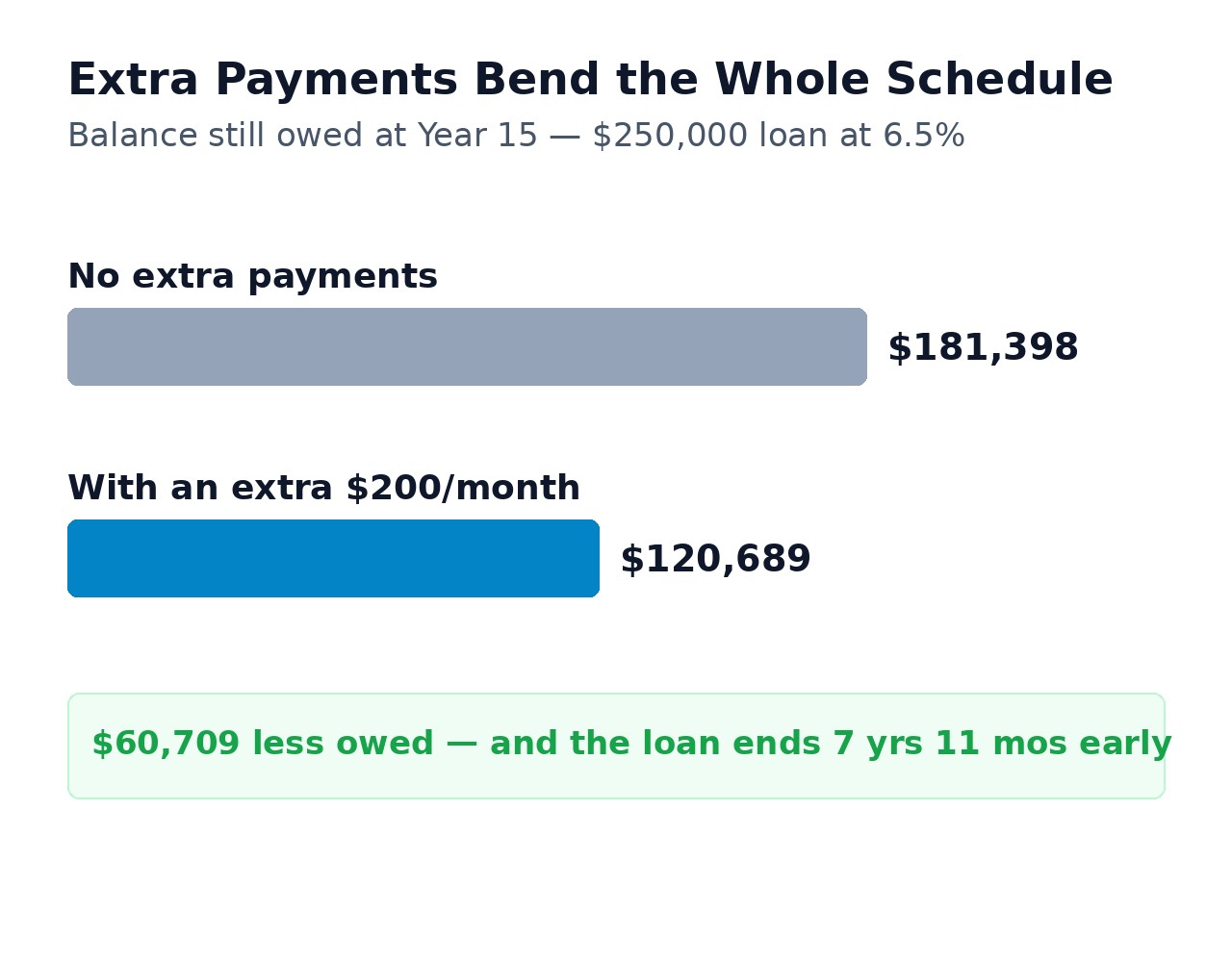
Compare the balance at three checkpoints, with and without the extra $200 a month:
- After 5 years: $219,893 with extra vs $234,027 without — a $14,134 head start
- After 10 years: $178,260 with extra vs $211,940 without
- After 15 years: $120,689 with extra vs $181,398 without — over $60,000 ahead
That gap is the whole strategy in one picture: extra payments do not just remove balance, they remove every future month of interest that balance would have generated. See the full effect broken down in our guide on how an extra $200 a month affects your mortgage, or run every scenario in the main mortgage payoff calculator with extra payments.
How to Print or Save Your Schedule
Set your numbers in the calculator, choose Yearly or Monthly view, then press Ctrl+P (Windows) or Cmd+P (Mac) in your browser and print — or save as PDF. The schedule on screen is the schedule that prints.
Frequently Asked Questions
1. How is an amortization schedule calculated?
Each month, interest is charged on the remaining balance (balance × annual rate ÷ 12). The rest of your payment — plus any extra you add — reduces the balance. Repeating that calculation month by month produces the full schedule.
2. Why does the balance fall so slowly in the first years?
Because early on the balance is at its highest, so interest takes most of each payment — on a $250,000 loan at 6.5%, $1,354 of the first $1,580.17 payment is interest. As the balance falls, the split flips in your favour. Extra payments speed up that flip.
3. Does this schedule include taxes and insurance?
No — like most amortization schedules, this one covers principal and interest only. Taxes, insurance and escrow vary by property and are handled separately by your servicer.
4. My lender's schedule looks different. Why?
Small differences come from rounding, the exact day payments are credited, and whether your servicer applies extra payments the day they arrive. The totals here use the standard amortization formula and match lender math to within normal rounding.