How Property Taxes and Homeowners Insurance Affect Your Mortgage Payoff
Here is the part of your mortgage payment nobody warns you about: on a typical payment, a big slice never touches your loan at all. On our running example - a $250,000 loan at 6.5% on a $300,000 home - the monthly check is $2,115.17, but only the $1,580.17 principal-and-interest portion has anything to do with the loan. The other $535 a month is property taxes, homeowners insurance and PMI, collected through escrow. Those costs do not change your interest by one cent - but let them rise unchecked and they can quietly push your payoff date years later. This guide shows exactly how.
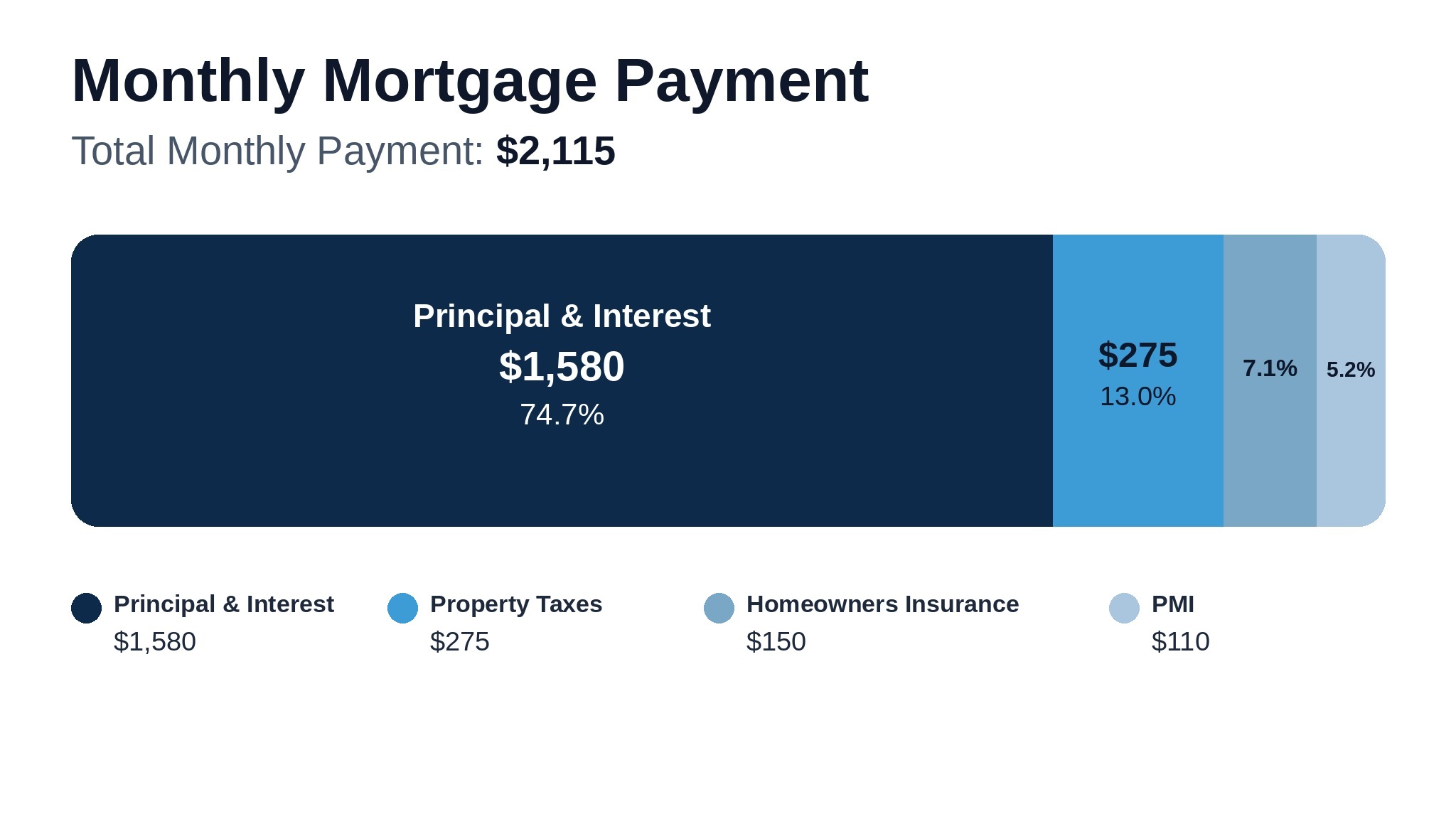
Your Payment Has Four Parts - Only One of Them Fights Your Loan
Lenders call the full payment PITI: Principal, Interest, Taxes and Insurance. If you bought with less than 20% down, there is usually a fifth line: PMI (private mortgage insurance). Here is the example payment, split honestly:
| Part of the Payment | Per Month | Where It Goes | Reduces Your Balance? |
|---|---|---|---|
| Principal & interest | $1,580.17 | Your lender, per the amortization schedule | Yes - the principal slice only |
| Property taxes | $275.00 | Escrow, then your county ($3,300/year in this example) | No |
| Homeowners insurance | $150.00 | Escrow, then your insurer ($1,800/year in this example) | No |
| PMI | $110.00 | An insurer protecting your lender (example premium) | No - but it can be removed |
Total check: $2,115.17. And even inside the $1,580.17, only the principal portion shrinks the loan - in month one that is just $226.00, while $1,354.17 goes to interest. So in the first month of this mortgage, barely a tenth of the money leaving your bank account actually reduces what you owe. That is not a scam; it is how the four parts work. But it means every payoff plan that only looks at the loan is planning with three-quarters of the picture.
How big the tax slice is depends heavily on where you live. Effective property tax rates - the tax actually paid as a share of home value - average roughly 1.88% in New Jersey and Illinois, the highest in the country, versus about 0.29% in Hawaii, the lowest, according to the Tax Foundation's analysis of Census Bureau data. Same house, same loan, wildly different escrow. Insurance varies just as much, driven by your home's replacement cost, local weather and fire risk, your deductible and your claims history.
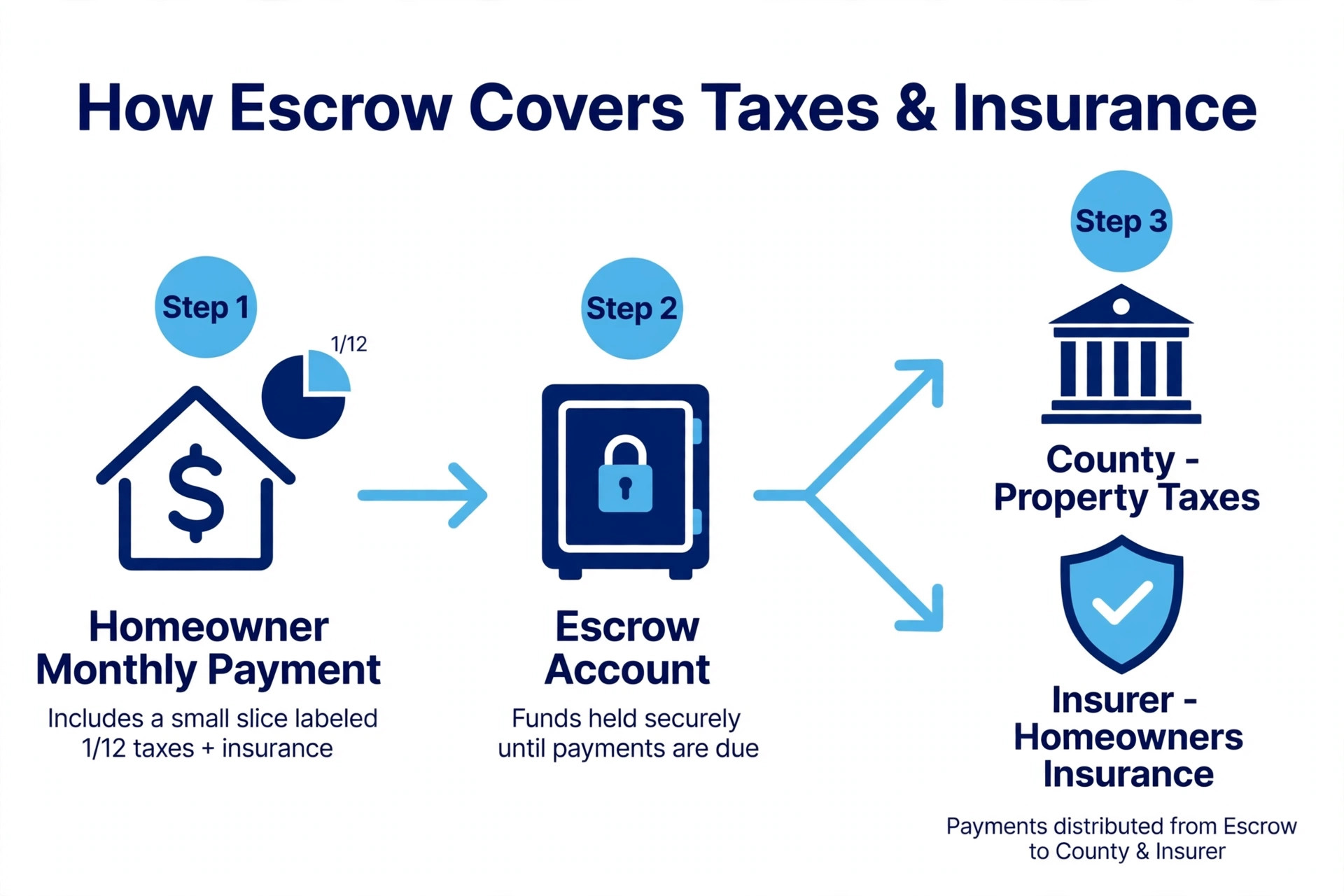
Escrow Explained: The Holding Account in the Middle
Most borrowers do not pay property taxes and insurance directly. Instead, the servicer adds one-twelfth of the estimated annual bills to each monthly payment and parks it in an escrow account. When the tax bill and the insurance premium come due, the servicer pays them out of that account. You never see the big bills - you just see the steady monthly slice.
Three escrow rules matter for payoff planning, and all three come from federal regulation (RESPA / Regulation X, overseen by the CFPB):
- The cushion is capped. Your servicer may keep a safety cushion in the account, but federal law limits it to about two months of escrow payments (one-sixth of the year's expected bills). On this example's $5,100 a year in taxes and insurance, the maximum cushion is $850 - not a penny more.
- There is an annual escrow analysis. Once a year the servicer compares what it collected with what the bills actually were, projects next year's bills, and resets your monthly escrow amount. This statement - not your interest rate - is why a fixed-rate borrower's payment changes.
- Shortages get spread, surpluses over $50 get refunded. If the account comes up short, the servicer can spread the shortage over at least 12 monthly payments (you may also pay it in a lump sum). If you overpaid and the surplus is more than $50, it must be refunded to you.
The payoff-relevant point: your escrow amount is recalculated from your bills, never
from your loan balance. Paying extra principal does not lower it. Only lower tax bills,
cheaper insurance - or removing PMI - bring the non-loan part of your payment down.
Worked Example: The Day the Escrow Analysis Arrives
Stay with the same loan: $250,000 at 6.5%, principal and interest fixed at $1,580.17 for all 30 years. Now suppose that at an annual escrow analysis, your county reassesses and the tax bill rises from $3,300 to $3,960 a year, and your insurer raises the premium from $1,800 to $2,160 a year. Here is what happens to the check:
| Monthly Amount | Before | After the Analysis | Change |
|---|---|---|---|
| Principal & interest | $1,580.17 | $1,580.17 | $0 - fixed by your loan |
| Escrow (taxes + insurance) | $425.00 | $510.00 | +$85.00 (higher bills) |
| Escrow shortage repayment | $0 | $50.00 | +$50.00 for 12 months ($600 shortage) |
| Total monthly check | $2,005.17 (plus PMI) | $2,140.17 (plus PMI) | +$135.00 |
Notice what did not happen: your loan did not change at all. Same balance, same rate, same payoff date - if your extra principal payments survive. That "if" is where taxes and insurance really bite, and it is the subject of the next section.
How Rising Taxes and Insurance Actually Move Your Payoff Date
Escrow increases never touch your loan directly. They move your payoff date through your budget. Say you were paying an extra $200 a month to principal - the strategy that pays this loan off in 22 years and 1 month and saves $97,618, as the extra $200 a month guide shows in full. The $135 escrow jump lands, money gets tight, and the extra payment is the easiest thing to cut. Trim it from $200 to $115 to keep your total outlay about the same, and here is the real cost:
| Extra Principal | Paid Off In | Total Interest | Result |
|---|---|---|---|
| $200/month kept | 265 months (22 yrs 1 mo) | $221,243 | Plan survives the escrow rise |
| Cut to $115/month | 297 months (24 yrs 9 mos) | $253,227 | 32 months later, $31,984 more interest |
The tax and insurance bills themselves cost $135 a month. Letting them eat your extra principal costs $31,984. That is the honest way taxes and insurance affect a mortgage payoff: not through the loan's math, but through the payment you can sustain. The defense is to plan for it - assume your escrow will rise over a 30-year loan (tax assessments and insurance premiums rarely stand still), and set your extra principal at a level that survives a bad escrow year, not one that only works if nothing ever changes. When you map your own loan, the amortization schedule with extra payments shows the month-by-month balance the escrow is sitting on top of.
PMI: The One Insurance Cost You Can Actually Delete
Homeowners insurance protects you and the house. PMI protects your lender - and you pay for it, typically because your down payment was under 20%. The good news: unlike taxes and hazard insurance, PMI has a legal exit. Under the federal Homeowners Protection Act, for most conventional loans:
- At 80% loan-to-value, you can ask. Once your balance reaches 80% of the home's original value, you may request cancellation in writing (conditions apply: you generally need to be current, with a good payment history, and the servicer may require evidence the value has not dropped).
- At 78%, it ends automatically. If you never ask, the servicer must terminate PMI when the balance is scheduled to reach 78% of original value - as long as you are current.
- At the loan's midpoint, it ends no matter what. If PMI somehow survives that long, it must terminate at the midpoint of the loan term (year 15 on a 30-year loan) for a current borrower.
Now watch what extra principal does to those dates on our example. The home's original value is $300,000, so 80% is a balance of $240,000. On the standard schedule, the balance reaches $240,000 at month 40. With an extra $200 a month, the actual balance gets there at month 23 - and because cancellation can be based on your actual payments, you can request PMI removal 17 months sooner. At this example's $110 monthly premium, that is about $1,870 of PMI you simply never pay - on top of the interest saved. Two cautions: government loans play by different rules (FHA charges its own mortgage insurance premiums, with different removal terms), and lender-paid PMI, which is built into a higher rate, cannot be cancelled this way at all.
Run the Loan Side With Your Own Numbers
The calculator below handles the loan side - principal, interest and extra payments. Your taxes, insurance and PMI ride on top of whatever it shows, so add your own escrow amount to the monthly figure when you judge what you can afford:
Loan Parameters
Extra Payments
| Period | Payment | Principal | Extra | Interest | Balance |
|---|
5 Mistakes That Quietly Wreck Payoff Plans
- Budgeting only the principal-and-interest number. The loan quote is not the payment. Plan around the full check - PITI plus PMI - or the first escrow analysis will "surprise" you.
- Treating an escrow shortage notice as an error. It usually just means last year's bills were higher than estimated. Compare the statement against your actual tax bill and premium before you dispute it - then choose the 12-month spread or a lump sum deliberately, not by default.
- Sending extra money without saying "principal only". Escrow confusion cuts both ways: money you meant for principal can sit in the wrong bucket. Instruct your servicer in writing, and check the next statement to confirm where every extra dollar went.
- Forgetting PMI has an exit date. Nobody will tap you on the shoulder at 80% loan-to-value - automatic termination only arrives at 78% on the original schedule. If extra payments got you to 80% early, request cancellation and stop paying for insurance that protects someone else.
- Never shopping the insurance half. Your premium is one of the few lines you can influence: review coverage and deductible at renewal, and get competing quotes. A lower premium means a lower escrow slice every month for as long as you hold the policy.

Frequently Asked Questions
1. Do property taxes and homeowners insurance count toward paying off my mortgage?
No. They are collected with your payment but held in escrow and paid out to your county and your insurer. Only principal payments reduce your loan balance, and only interest is the cost of the loan itself. Taxes and insurance affect your payoff only indirectly - through what you can afford to add as extra principal.
2. My rate is fixed, so why did my monthly payment go up?
Almost certainly the escrow portion. At the annual escrow analysis your servicer recalculates the monthly amount from your actual and projected tax and insurance bills. If the bills rose - or last year's collections fell short - the payment rises even though your principal and interest never changed.
3. Can I pay my taxes and insurance myself instead of using escrow?
Sometimes. Some loans require escrow for the life of the loan, while others allow a waiver once you have substantial equity and a clean payment record - the rules depend on your loan type and lender. If you do opt out, the discipline is on you: the bills are large and infrequent, and a missed tax payment can put a lien on your home.
4. When can I get rid of PMI?
On most conventional loans, under the Homeowners Protection Act: you can request cancellation in writing when your balance reaches 80% of the home's original value, it must terminate automatically at 78% on the original schedule if you are current, and it cannot continue past the midpoint of the loan term. Extra principal payments that bring your actual balance to 80% sooner can support an earlier request.
5. Does paying extra principal lower my escrow payment?
No. Escrow is calculated from your tax and insurance bills, not from your balance, so extra principal leaves it unchanged. The one exception is PMI: extra principal gets you to the cancellation thresholds sooner, and removing PMI does shrink the total check.
Taxes and insurance are the part of homeownership that never gets paid off - but they do not have to derail the part that does. Keep the escrow slice in your budget from day one, defend your extra principal when the analysis letter arrives, and take PMI off the table the moment the law allows. Then run your full plan through the main mortgage payoff calculator with extra payments and see your real payoff date.
Disclaimer: This guide is for general education only and is not financial, tax, legal or mortgage advice. Calculator results and examples are estimates based on the figures shown; your actual taxes, insurance premiums, PMI and escrow requirements depend on your property, policies, loan type and servicer. Confirm the details - including PMI cancellation conditions and any prepayment rules - with your lender or servicer, and consult a licensed professional for decisions about your own mortgage.